

Why dotSource Is the Right Interface Development Agency for You
Complex interfaces rarely emerge on a blank slate. In most cases, unstable system landscapes already exist or new platforms need to be integrated. In addition, data flows across multiple business units must be orchestrated reliably. It is precisely in projects like these that dotSource has been providing support for more than 20 years.
With over 700 digital projects, you benefit from experience gained across demanding integration scenarios – from commerce and content platforms, product information management (PIM), customer relationship management (CRM) and enterprise resource planning (ERP) software to bespoke third-party systems and partner integrations.
What You Get with dotSource
- A partner with a deep understanding of source and target systems
- An integration architecture that brings together technology and business processes
- A robust foundation for platform development, automation and continuous improvement
- Interface management that does not end with implementation
This allows you to create not only working connections, but also a system landscape that stands up to everyday demands and grows with your requirements.
Our Process for Successful Interface Development
1. Analysis and Strategy Development

Your goals, systems and use cases are at the heart of everything:
- Which processes need to be integrated?
- Which data flows where?
- What role does AI play today and tomorrow?
On this basis, we develop an integration and interface strategy that brings together business units, IT and governance.
2. Concept Creation and Architecture Design

In the next step, a robust blueprint is developed:
- Target architecture
- Integration patterns (APIs, events, iPaaS flows)
- Security and governance models
- Interaction between your systems and AI interfaces
This makes it clear which interfaces you need.
3. Technology Selection
Based on your strategy and architecture, you receive the right technologies and platforms – from integration platform as a service (iPaaS) and application programming interface (API) management solutions to AI integration components.
The selected tools are aligned with the following aspects:
- Your existing system landscape
- Your team
- Your growth plans
4. Change Management and Enablement

Your teams and stakeholders are all in the same boat:
- Clarifying roles and responsibilities
- Defining processes
- Empowering your employees
This enables you to use and enhance interfaces and APIs independently.
5. Operations and Ongoing Optimisation

After launch, the process does not end:
- Monitoring
- Error handling
- Version management and security
All these ensure stable operations. Based on usage data and new requirements, we optimise interfaces and you can integrate new systems seamlessly.
Arrange a Consulting Session Now and Benefit from Well-Integrated Systems
Your Contact for Further Questions

You Will Hear from Us Soon
- Our experts will take your enquiry and get back to you within one working day.
Our Strong Partners in the Field of iPaaS and API Management





How Companies Use Interface Development in Practice




What Is Interface Development?
Interface development ensures that your systems, data and processes work together seamlessly. It includes the planning and management of all connections between your applications and the associated data sources and services so that information is delivered in a structured, secure manner and with the right level of quality – wherever it is needed.
Why Interface Development Is Essential in Digital Business
Without structured interface development, integrations often grow in an unplanned way: Point-to-point connections, manual exports, isolated solutions and initial AI experiments quickly lead to data silos and an IT landscape that is difficult to control and prone to errors. With a clear interface strategy, you create a stable foundation on which systems and AI applications work together reliably. This allows you to reduce operational effort and bring new digital services to market more quickly.
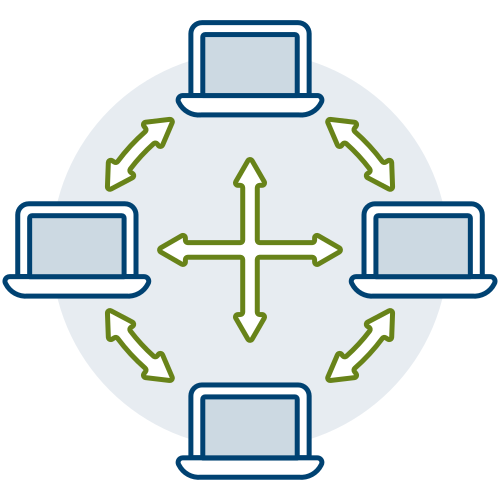
iPaaS: Centralised Control of Complex Data Flows
- Replaces rigid point-to-point integrations and consolidates data flows on a centralised integration platform
- Reduces manual imports/exports and susceptibility to errors through standardised, reusable flows
- Enables faster connection of new systems and partners without having to start from scratch each time

API Management: Transparency, Security and Reusability
- Creates transparency by ensuring that interfaces are centrally documented and monitored.
- Increases security and compliance through clear policies for access and load management
- Uses a developer portal to make your existing features and data available to teams and partners in a controlled manner

AI and MCP: Controlled Integration of AI into Your Systems
- Prevents uncontrolled direct access by AI models to databases or standalone solutions without governance
- Leverages standardised interfaces and contexts (e.g. MCP) to ensure that AI models only access approved data and perform defined actions
- Builds a scalable foundation for rapidly and securely implementing additional AI use cases throughout your existing system landscape
Other Agency Services at a Glance








FAQ – Frequently Asked Questions About Interface Management
How do interface management and traditional system integration differ?
Traditional system integration often focuses on individual projects: Two or three systems are connected so that a specific use case works. Interface management goes further and views your integrations as a connected landscape – with a clear architecture, reusable patterns (APIs, events, iPaaS flows), governance and monitoring. This does not create a patchwork of isolated solutions, but an integrated foundation for many current and future use cases, including AI.
At what company size or level of complexity does structured interface management become worthwhile?
The investment becomes worthwhile as soon as you have more than just a handful of static integrations, typically once several core systems are involved (e.g. ERP, CRM, PIM, shop, marketing tools), data volumes are growing or you are operating international or multi-brand setups. If changes to one system keep triggering unforeseen effects in others or you are about to launch AI projects, structured interface management is a smart business move.
How do I deal with legacy integrations?
In many companies, there is already an established landscape of point-to-point integrations, scripts and standalone solutions. Instead of rebuilding everything at once, a phased approach is usually advisable: Critical and strategically important integrations are prioritised, migrated to the new architecture (e.g. iPaaS, API management) and kept running reliably in parallel. This reduces risks, allocates budgets sensibly and gradually creates a more transparently structured integration landscape.
Which in-house roles and skills do I need for successful interface management?
Successful interface management is a team effort involving business departments and IT. Typical roles include, for example, a product owner for integrations/APIs, an enterprise or integration architect, developers with API/iPaaS experience as well as those responsible for security and governance. On the business side, clear points of contact are required to define processes and data requirements and prioritise them together with IT. External partners can complement these roles, but internal understanding remains crucial.
How do I measure the success of interface management?
In addition to technical metrics (availability, throughput, error rates), business-related key performance indicators can be taken into account, for example reduced manual effort (imports, exports, data corrections), faster time to market for new features or channels, fewer order or master data errors, lower return rates due to better data quality or shorter processing times in customer service. Interface management is also highly effective when it comes to AI projects, for example through higher usage rates, more automated processes and fewer errors in AI-powered workflows.