

AI Security in Numbers
billion Euro
was the total damage suffered by German companies as a result of cyberattacks in 2024.
of companies
invest in their cyber security strategy. Nevertheless, more than half were affected by cyber attacks in 2024.
of security managers
see AI, LLMs and data protection issues as the biggest concern – even ahead of ransomware, malware and data extortion.
Why dotSource is the Right Partner for AI Security
- Receive advice from experts who understand both modern technologies and regulatory requirements, as well as the realities of business. This ensures that the use of AI does not fail due to data protection, IT security or a lack of acceptance.
- Benefit from our expertise gained through a wide range of technology projects. Whether it is intelligent processes in e-commerce, CRM, data management or digital marketing. We develop secure use cases that integrate seamlessly into your existing system landscape.
- Work with a partner that trials new AI technologies in its own business first. We test our own AI applications, including MCP integration, in real processes, learn from them and refine our approach before rolling out solutions for you. This means you benefit from best practice rather than experiments.
Your Path to Secure AI Use with dotSource
1. AI Security Consultation

- Assessment of where and how AI is already being used in your company today
- Identification of typical weaknesses in the use of AI systems
- Prioritisation of risks based on business impact, regulatory relevance and implementation effort
- Compliance with legal requirements such as the General Data Protection Regulation (GDPR)
2. Design of a Secure AI Architecture
- Design of an IT infrastructure that fits your existing system landscape
- Definition of roles, permissions and governance models for the secure use of AI
- Development of security and compliance policies that also cover future use cases
3. Implementation & Integration
- Technical implementation of the defined security measures in your AI infrastructure
- Securing interfaces, models and connections
4. Enablement & Secure Use
- Training for specialist departments and IT, so that AI can be used securely, efficiently and compliantly
- Development of guardrails and best practices for prompts, data handling and tool selection
- Support with the implementation of secure AI use cases
5. AI Quality Assurance
- Establishing Quality Assurance (QA): continuous review of responses, automations and decisions for quality, hallucinations and security risks
- Support for new projects, so that every additional “open door” is planned securely from the outset
How Secure are Your Processes? Find Out in Our AI Security Consulting Session
Your Contact for Further Questions

We will respond to your enquiry as quickly as possible
- Our AI experts will review your enquiry and contact you within one working day
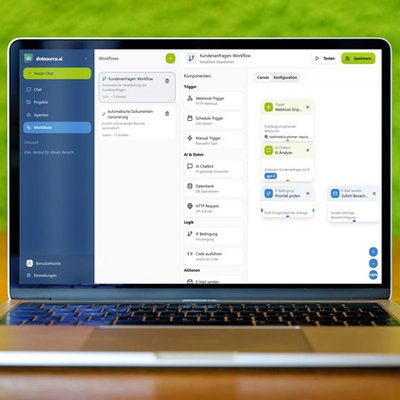
AI, but Secure. At Every Stage.
Artificial intelligence now permeates all areas of business: from IT and service to marketing and sales. New developments such as AI agents, AI assistants and MCP are ensuring that systems that previously operated in isolation are now interconnected. This opens the door to entirely new workflows and efficiencies.
But Here Comes the Challenge:
Every door you open to AI models can also become a point of entry. Unsecured interfaces, unchecked prompts and uncontrolled data flows leave your infrastructure vulnerable.
The reality: Opting out of AI is not an option. If you wait now, you will fall behind the competition. But using it without the right protective measures is negligent.
The Good News:
Security is not an obstacle to innovation. It is its prerequisite. dotSource helps you open the right doors and close those that are better kept shut.
The Dark Side of AI: Risks for Your Company
LLMs can be manipulated. Attackers deliberately inject malicious prompts via input fields, chats or APIs to alter the model’s behaviour. The result: unwanted outputs, data disclosure or manipulated decisions. Without anyone noticing.
AI models learn from the data they are trained on. And they reveal information. Sometimes accidentally, sometimes through targeted attacks. Confidential customer data, trade secrets or internal strategies can leak out. The result: reputational damage as well as serious breaches of the GDPR and the EU AI Act.
Employees are increasingly using private tools without the IT department being aware of it. This »Shadow AI« operates unchecked outside defined security policies. You do not know where your data ends up, who has access to it, or whether the models being used even comply with your company’s compliance standards.
Protocols such as MCP connect your AI systems to internal tools such as CRM, PIM and other business applications. However, every connection is also a potential security vulnerability. Without central monitoring and protection of these interfaces, »blind spots« emerge through which attackers can penetrate deep into your system landscape.
Other AI Services at a Glance


Frequently Asked Questions about AI Security
What is the difference between traditional IT security and AI security?
While IT security prevents unauthorised access, AI security ensures that the AI itself does not disclose sensitive data or make incorrect decisions, even when access is authorised.
AI security therefore addresses vulnerabilities in the algorithms directly. It prevents new forms of attack such as prompt injections or data poisoning, where the system is manipulated through targeted inputs in order to disclose sensitive data or make incorrect decisions.
Can we securely connect our existing data sources to AI?
Yes, we create secure, controlled channels to your internal systems, for example via the Model Context Protocol (MCP). In doing so, we define precise access permissions so that the AI only sees the data it needs for its task, without sensitive information leaving your company’s protected environment.
What role does AI security play in complying with the EU AI Act?
The EU AI Act classifies many business applications as high-risk systems, which entails strict requirements for robustness and cyber security. AI security is the technical response to this legal requirement: it provides the necessary evidence of resilience against attacks and ensures that AI outputs remain traceable and free from unauthorised manipulation.
When do we actually need our own AI security concept?
As soon as AI becomes more than an internal experiment. At the latest, when employees are working productively with assistants, chatbots or agents, or when AI is connected to internal systems, you need clear rules, roles and technical safeguards. Without a concept in place, the risk increases that data will be used in an uncontrolled way and that you will breach regulatory requirements.