

What Is a Headless CMS?
A headless CMS is a back-end content management system that operates without a traditional front end.
This means the system stores content in a universal database (content repository) and delivers it via various APIs (interfaces) to any front end you choose – whether website, app, or shop.
Precisely because content is constantly evolving in the course of digital transformation – in structure, design and use – companies need systems that grow flexibly with them.
With a headless CMS, your team is able to deliver your messages wherever your target audience is. Benefit now from greater productivity, agility and competitiveness.
Key Takeaways
- Separation of back end and front end
- Centralised management of content and delivery across any channels
- API-first for fast and secure integrations of diverse front ends
- Seamless integration with other systems such as CRM, e-commerce or PIM
An Overview of Headless CMS Benefits
Benefits for Content Managers
- Create content just once and reuse it across multiple channels
- More time for quality and the impact of your copy
- A better author experience through clear, simple workflows
Benefits for Developers
- Maximum freedom in the choice of programming languages and tools
- Unlimited extension options thanks to an API-first approach and high performance
- Efficient integration of systems for commerce, data management or marketing
Benefits for Customers
- Fast loading times and a modern user experience
- Consistent content across all channels
- Individually personalised content thanks to integration with customer and product data
Headless CMS Features: Fast and High-Performing
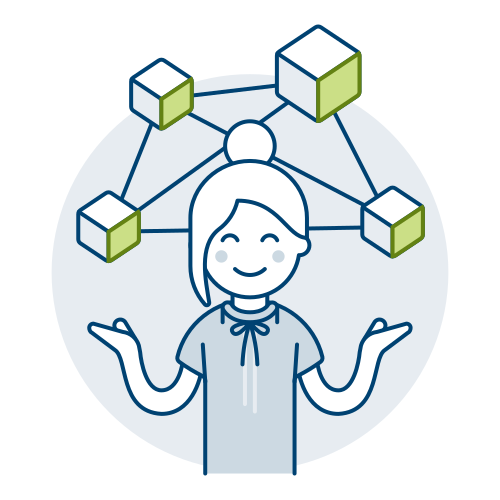
- Can be connected via APIs to any number of channels
- Seamless data exchange with common frameworks such as Vue, React, Angular or JAMstack
- Compatible with wearables, voice assistants, VR and IoT devices – including future developments

- Content grouped centrally in content hubs, available at any time for connected systems
- No unnecessary administrative overhead or complex content migrations
- More time for quality, storytelling and conversion optimisation

- Lean system with modular individual components
- Flexible expansion or optimisation as required
- Updates or maintenance during ongoing operation – full performance is maintained
- High IT security: The backend and modules remain protected against unauthorised access if security vulnerabilities arise in individual front ends
- Errors in individual front ends do not affect the speed and stability of the overall system

Traditional CMS vs. Headless CMS
Traditional CMS (e.g. WordPress, TYPO3, Drupal)
- Monolithic structure combining backend and frontend
- Fixed layouts and limited functionality
- Suitable for smaller businesses or shops
- Extensions via REST APIs are generally possible
- However: additional system integrations often involve a high level of effort
Headless CMS (e.g. Magnolia, Contentful, Storyblok)
- Designed for dynamic and complex digital requirements
- Flexible, lean backend architecture
- Supports integration with a wide range of front ends and devices
- Extensive scope for extensions and integrations
- Future-ready and scalable for growing digital ecosystems
How Does a Headless CMS Work?
In a headless CMS, all content is stored in the backend. The content is unformatted but structured, meaning it includes, for example, a title, description, image and links. The structured data is clearly organised by content types, such as sliders, banners or blog posts.
Via APIs, the CMS can deliver individual pieces of content to different templates and front ends. The possibilities for linking and connecting additional databases are virtually limitless.
As a result, a headless CMS can not only distribute content automatically across different channels, but also retrieve it directly from connected systems such as DAM (Digital Asset Management) or product databases.
Setting up a Headless CMS
API
APIs form the heart of headless content management systems. They enable countless extensions. Via REST APIs such as GraphQL, data & information are exchanged with the backend.
Back End
The back end is the second component of a headless CMS. This is where content (texts, images, videos, etc.) is created, managed and shared as usual.
Front Ends
Front ends (templates, themes, layouts) are not a direct component of the headless CMS, but can be implemented and managed individually, precisely and independently. The data simply needs to be available in the backend; the linked front end takes care of the rest itself.
Databases
External databases (product databases, etc.) and microservices can also be quickly integrated and accessed with a headless CMS.

Move to a Headless CMS with Our Top Technology Partners




Why Content Teams Trust dotSource as Their Headless CMS Partner
Together with our team, you can create innovative CMS solutions that enable you to deliver excellent customer experiences to your target audience across all channels. Thanks to successful projects with renowned companies such as hessnatur and Villeroy & Boch, our team knows what it takes to build future-ready e-commerce. Secure this expertise now.
Clients such as Hagebau, Fissler and Ottobock value close collaboration with dotSource throughout the entire project process. Thanks to agile working methods, our team can implement your requirements flexibly, even if they change from time to time.
Get more out of your headless CMS. With effective consulting from our CMS experts, you can unlock synergies across your existing system landscape, from PIM to e-commerce systems.
No project idea is too big. With dotSource, you can deliver projects with parallel streams efficiently and sustainably. Benefit, for example, from the simultaneous implementation of a CMS and e-commerce platform, as our customer Angst+Pfister did.
Headless CMS Services: Everything to Drive Your Project Forward
CMS Strategy and Content Creation

- Development of a well-considered content strategy aligned with your business objectives
- Analysis of your current processes and structures in our discovery workshops
- Outlining specific CMS use cases
CMS Selection and Evaluation
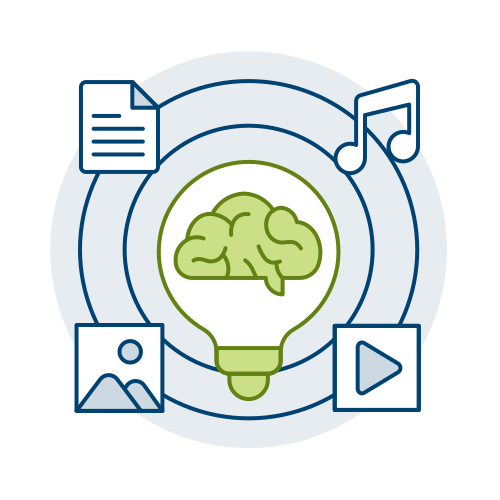
- Precise definition of your requirements
- Technology assessment of headless providers such as Contentful, Magnolia or Bloomreach
- Selection of the right headless CMS
CMS Implementation and Integration

- Implementation of the headless CMS in line with your requirements
- Integration of the headless CMS into your existing system landscape
- Central content delivery via APIs and iPaaS (Integration Platform as a Service) to all front ends
- Stabilisation and go-live support
Front-End Development and UX Design

- Development of high-performance, responsive front ends
- UX design that clearly communicates your brand messages
- Ensuring consistent user experiences across all touchpoints
Ongoing Development and Support

- Training for your teams to enable independent operation
- Continuous optimisation of your system, as well as support after project completion
Headless CMS Consulting by dotSource
A headless CMS opens up opportunities: publish content faster, manage campaigns flexibly across different channels, and streamline digital processes. But the transition is complex – the wrong decisions in strategy, system selection or integration cost time and money. That is why working with an experienced headless CMS agency pays off. In a personal consultation, you will find out which system fits your goals, how to unlock untapped potential, and how your platform can secure long-term success.
Your Contact for Further Questions

- Once we have received your enquiry, our team will get back to you within one working day. As soon as your enquiry reaches our team, we will process it immediately and respond within one working day
In the meantime, feel free to use our white paper on CMSs for further insights.
These Companies Are Already Succeeding with CMS Consultancy by dotSource








Discover Exciting Use Cases in Our Success Stories





FAQ – Frequently Asked Questions About Headless CMS
What is a headless CMS?
Generally speaking, a content management system is a software used to manage content across various channels such as websites, mobile apps and more. Traditionally, CMS platforms link the front end and back end together, but with a headless CMS, the front end (head) is removed. Instead, headless CMS platforms offer an excellent API architecture, allowing a wide range of front ends to be integrated with ease. This makes headless CMS particularly flexible and powerful.
Why do you need a headless CMS?
With its future-proof architecture, a headless CMS helps you respond effectively to the needs of customers and content creators. Headless CMS benefit from efficient performance, straightforward management and flexible delivery across all channels.
What is the difference between a decoupled CMS and a headless CMS?
Unlike a headless CMS, which consists only of a backend, a decoupled CMS has both a backend and a frontend. However, these are technically decoupled and connected via an API. Well-known examples of such CMSs are WordPress (via REST API) and Drupal 8 (via RESTful Web Services). We would be happy to assess which CMS is right for you in a joint consultation.
Who benefits from a headless CMS?
Headless CMS are ideal for businesses that run content marketing across multiple devices. They offer particular advantages in e-commerce for essential content such as product descriptions or event calendars. Media companies and publishers also benefit from fast, high-performance content delivery and can manage their content successfully over the long term.
How does the implementation of a headless CMS work?
The implementation of a headless CMS begins with defining the target system and target architecture. This is followed by the technical set-up, implementation of the requirements, API-based integration of front ends and adjacent systems, stabilisation before go-live, and training for the future users.
When is a headless CMS worthwhile for your business?
A headless CMS is particularly worthwhile if you want to manage content centrally and deliver it across multiple digital channels. This is especially relevant if, alongside your website, you also have shops, apps, portals or other front ends and require a flexible, integrable architecture.