

What Is a DXP?
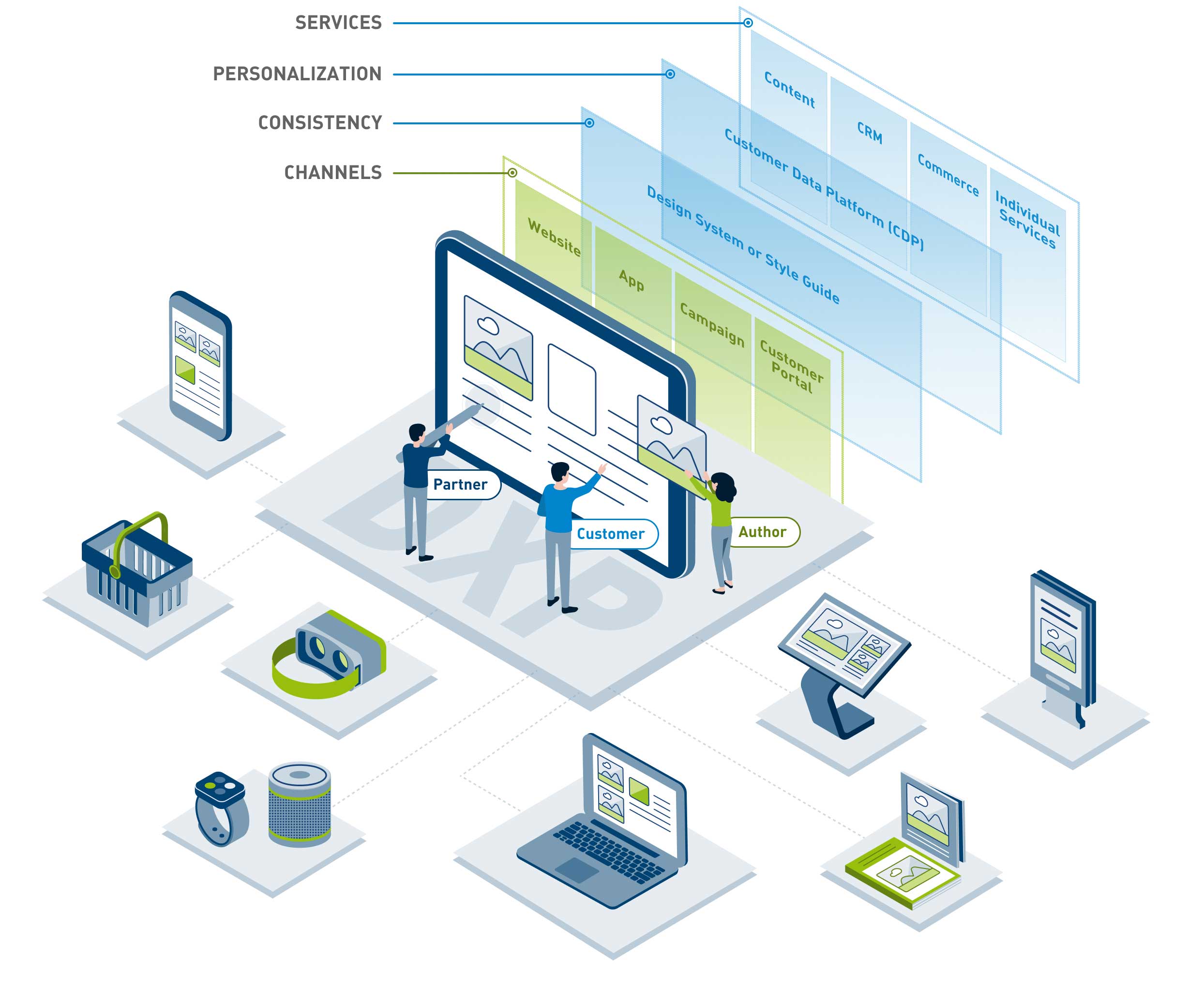
A DXP is a centralised system for managing digital customer experiences. It combines content management, customer data platforms, personalisation, e-commerce, marketing automation and analytics in a single solution. The goal is to create consistent, personalised and data-driven experiences across all digital channels in real time.
Unlike traditional content management systems, a DXP acts as a strategic hub: It brings content, systems and processes together so that you can respond quickly to market changes and customer needs. This applies to websites, apps, portals as well as IoT and voice applications.
Your Added Value: Benefits of a DXP in Figures
increased customer lifetime value
with a consistent customer experience.


6 Good Reasons for a DXP
Centralised Control of All Channels
With a DXP, you can control your website, mobile app, newsletter, social media and e-commerce centrally in one system. Your teams keep track of everything, reduce redundant processes and orchestrate content across all channels. This increases efficiency and accelerates digital communication.

Personalised Customer Experiences in Real Time
A DXP uses data from customer relationship management (CRM), web tracking and user profiles to automatically tailor content to individual user needs. This increases the relevance of your communication, strengthens customer loyalty and measurably improves conversion rates.
Intelligently Connected Existing Systems
Whether product information management (PIM) tool, content management system (CMS), CRM software or online shop: Modern DXPs can be flexibly integrated and connect your existing systems to form a continuous digital ecosystem. Our DXP consulting ensures that all interfaces work seamlessly – today and in the future.

Consistent Brand Communication
With a DXP, you can communicate consistently across all touchpoints. Colours, language, content and storytelling are intertwined – across all channels and in line with your brand. This creates recognition and trust among your customers.

Faster Content Launches
Marketing teams benefit from efficient campaign management: Content can be preconfigured, clustered and automatically delivered in the DXP. This shortens your time to market and allows you to remain flexible when new requirements arise.

Better Decision-Making with Data
Integrated analytics features allow you to keep track of your users' behaviour and preferences. The insights gained help you optimise content and steer strategies based on data.
Create Seamless, Consistent and Personalised Experiences for Users With a DXP
Learn More About DXP in This Video
Publications and Success Stories Around DXP



Why dotSource Is Your DXP Agency
- Benefit from over 20 years of experience in e-business: We support your digital platform projects from strategy to scaling.
- Get the most out of your DXP with our technology-agnostic DXP consulting tailored to your goals.
- Work with over 500 certified experts – united in agile, interdisciplinary teams.
- Leverage our platform expertise, e.g. for Adobe, Salesforce or SAP.
- Opt for solutions that work – no matter what industry you are in, we deliver strategy, technology and implementation from a single source.
- Intelligently network your DXP – with CRM, PIM, digital asset management, marketing automation, business intelligence (BI) and AI-powered processes.
- Plan securely and with clear communication, dedicated contacts and forward-looking project management.
Implement Your DXP Project with Our Services
A DXP combines multiple components into one seamless system. To ensure that a DXP delivers real added value, it is first necessary to check which building blocks already exist, which are missing and what requirements exist within the company. On this basis, a project plan is created that harmonises strategy, technology and implementation.
1. Requirements Analysis

Together we analyse your existing system landscape under consideration of all relevant processes. This allows us to identify strengths, uncover gaps and define specific requirements.
2. Strategy and Roadmap

Together we develop a digital strategy that fits your business model. This results in a roadmap that sets clear goals, creates investment security and provides guidance for the next steps.
3. System Selection and Architecture Concept
In close collaboration with you, we evaluate suitable platforms. We then develop an architecture concept that connects all components of your DXP in a scalable and flexible manner.
4. Implementation and Integration

Step by step, we implement the selected systems and integrate them seamlessly into your existing IT landscape. The result is a consistent ecosystem that allows for a smooth customer experience across all channels.
5. Launch and Further Development

After the successful launch, we continue to provide training and support. Together we continuously optimise the platform – through analytics, BI, AI and automation. This allows your DXP to grow with the requirements of your business.
Together We Get Your DXP Project off the Ground
You Will Hear from Us Soon
- Our experts will take your enquiry and get back to you within one working day.
Your Contact for Further Questions

Additional Services: What Is Missing on Your Way to a DXP?








Frequently Asked Questions
How does a DXP differ from a CMS?
A CMS manages content. A DXP goes further, integrating additional systems to create personalised, data-driven customer experiences.
Who is a DXP suitable for?
It is suitable for companies with complex touchpoints that want to orchestrate customer data, content and processes in a central platform.
How can you build a DXP?
First, evaluate your business goals. What do you want the DXP to do for you? Next, define the technologies you need and plan their implementation. Leverage our professional support for migrating data and testing your systems. We are also available to train your team in using the new DXP.
How does DXP consulting work?
Together we analyse your current situation, define requirements, select suitable systems and develop a roadmap for implementation and scaling.