
Companies Turn to dotSource With These Data Management Challenges
- Product, master and media data are spread across multiple systems and departments
- Data is incomplete, inconsistent or prone to errors
- You lack a central, reliable data foundation as a »single source of truth«
- Manual maintenance processes cost time and prevent efficient workflows
- Different channels and markets require consistent data in various formats
- Images, documents and other assets are difficult to find or not properly organised
- Legacy system landscapes make integration, transparency and scalability more difficult
- Automation and AI initiatives fail due to poor data quality
PIM, MDM or DAM? Start Your Data Journey Here
A data management system is not a one-size-fits-all solution – it has to align with your data structure, processes and objectives. That is why every successful project begins with a sound strategy. We support you with strategic guidance, technical expertise and solutions tailored to your requirements.

A PIM system is the perfect fit if you need to manage large assortments, multiple sales channels and complex product information.

A DAM system is ideal if your focus is on organising, distributing and versioning digital assets such as images, videos and documents.
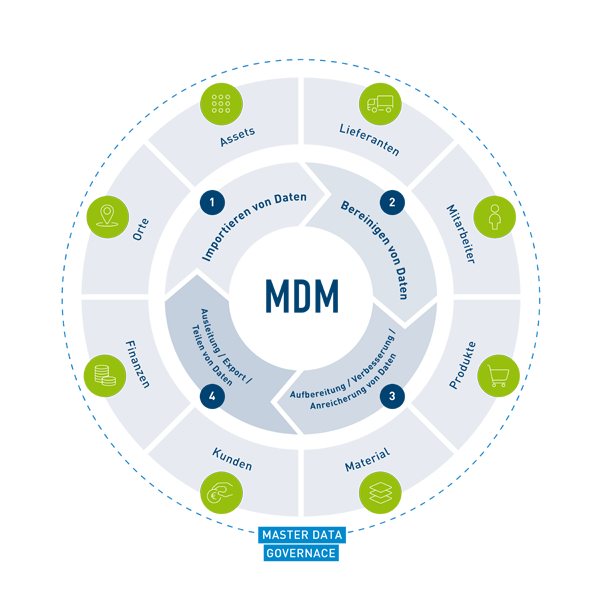
An MDM system is the right choice if you want to build a single source of truth for product, customer and supplier information.
Put Your Trust in dotSource as Your Data Management Agency
Benefit from a partner with over 20 years of e-commerce experience. We know just how crucial high-quality product data, consistent assets and clean master data are to your sales success.
Work with an agency that understands a wide range of requirements from over 700 B2B and B2C projects. We draw on our many years of experience across various industries to develop tailored solutions for your individual challenges.
Whether AI, automation or intelligent data processes: we translate technological innovations into practical applications for your data management at an early stage.
Whether it’s the Digital Product Passport (DPP) or the German Supply Chain Due Diligence Act (LkSG): thanks to our sound specialist expertise and in-depth system understanding, we ensure that your data fully and efficiently meets all legal requirements.
Our Process for Your Successful Data Management
1. Data Analysis

Analyse your data landscape and precisely capture your processes, systems and requirements.
2. Strategy

Development of a tailor-made digital strategy and support with system selection and target architecture.
3. Data Preparation
Structuring and cleansing your data for consistent, cross-system use.
4. Implementation
Seamless implementation and configuration of your system as well as integration into your existing IT infrastructure.
5. Optimisation

Optimisation of your internal processes and workflows, for example by connecting your AI agents via MCP servers.
6. Training and Further Education

Professional and technical upskilling of your teams as well as further development.
Data Management Consulting Session
Your Contact for Further Questions

You Will Hear from Us Soon
- Our experts will take your enquiry and get back to you within one working day.
Our Powerful PIM, MDM and DAM Solutions






These Companies Already Rely on dotSource as Their Data Management Agency
















How Our Clients Drive Growth and Efficiency with a Data Management System




What Is a Data Management System?
A data management system serves as a centralised platform for structuring and managing business-critical information – from product information and master data to digital assets. Its purpose is to deliver consistent, up-to-date data across all channels – at any time.
There are three types of data management systems, each playing a distinct role:
- Product information management (PIM) software enables you to consolidate product data in one place and make it available across all sales channels.
- Master data management (MDM) software allows you to establish a single source of truth for master data, covering everything from products and customers to suppliers.
- Digital asset management (DAM) software helps you store, version and deliver digital assets that are optimised for every channel.
Together these systems form the foundation for automated processes, faster time to market and a seamless customer experience.
Why Centralised Data Management Matters
Safeguarding Data Quality Through Centralised Management
A data management system provides a structured framework for handling business-critical information, minimising redundancies, preventing inconsistencies and reducing sources of error. Whether product descriptions, images or technical specifications: Data is always accurate and up to date, resulting in significant efficiency gains and a stronger foundation for your business.

Accelerating Time to Market Through Process Automation
A PIM, MDM or DAM system helps you reduce manual effort, automate workflows and speed up product launches. Seamlessly connected processes ensure faster time to market – a clear competitive advantage, especially in seasonal business or when managing complex assortments.

Conserving Resources Through Intelligent Data Reuse
In today's world, data has to be available across a wide range of systems and channels. A centralised data management system brings together content for e-commerce, marketing and sales, enabling single-source data entry and cross-platform reuse – from enterprise resource planning (ERP) tools to online shops. This helps you save resources and boost efficiency across all departments.
German Supply Chain Due Diligence Act: How a Data Management System Helps You Stay Compliant
Social and environmental responsibility is becoming increasingly important – for consumers, investors and society as a whole. With the German Supply Chain Due Diligence Act (SCDDA), human rights and environmental due diligence obligations in corporate supply chains are now enshrined in law. Powerful data management systems make it easier to meet these legal requirements while strengthening your corporate social responsibility (CSR) strategy.

Data Collection and Availability
Under the SCDDA, you are obliged to gather comprehensive data on your business practices, supply chains, environmental impact, risks and social performance metrics. Ensuring the availability and quality of this data can be challenging.
- In a PIM or MDM system, you can set up dedicated repositories to capture, store and manage data for each business unit.
- Integrated asset management allows you to keep track of key certificates, contracts and complaints.

Data Validation and Authenticity
The accuracy and authenticity of the data you collect are critical to reliable reporting. Verifying and validating this data can be a time-consuming and complex endeavour.
- With a PIM or MDM system, you can keep essential product information front and centre (e.g. expiration dates and product-specific CO₂ metrics).
- By leveraging a DAM tool and artificial intelligence (AI), you can check the authenticity of supplier and partner documents.

Integration of Data Systems
To ensure consistent data collection, processing, analytics and visualisation, you often need to integrate data from multiple systems – a technical challenge for many businesses.
- A PIM or MDM system helps you consolidate and manage data from your ERP tool, online shop and supplier portal in one place, establishing a golden record.

Understanding of Metrics and Standards
Defining clear metrics and standards for CSR performance – and automatically integrating them throughout your business – can be difficult. You may need to invest time and resources in manually editing data.
- Data management systems let you establish data quality standards and automate recurring workflows to reduce manual effort.
More About Data Management Systems
Our Data Management Services

FAQ – Frequently Asked Questions About Data Management Systems
What is the difference between PIM, DAM and MDM?
PIM is used for the central management and distribution of product information across various sales channels. DAM manages digital assets such as images, videos or documents and ensures version control and media-appropriate delivery. MDM creates a central, company-wide data foundation for master data, for example relating to products, customers or suppliers.
What services does dotSource provide as a data management agency?
dotSource supports data management projects from analysing the data landscape through strategy, system selection and data preparation to implementation, integration, process optimisation and training. Depending on requirements, this also includes preparation for regulatory requirements, connecting existing systems and the further development of the data architecture.
Do we need PIM, DAM or MDM? And where should we start?
That depends on your bottleneck: PIM for product information, DAM for media, and MDM for company-wide master data. We analyse your data structure, processes and goals and recommend the most sensible place to start.
How complex is the implementation of a data management system?
The effort involved depends primarily on data quality, the system landscape and the objectives. With good planning, the implementation can be managed in a targeted and controlled way.
How quickly will you see business value from a PIM, DAM or MDM project?
Typical benefits include higher data quality, less manual effort and faster publishing processes. The value often becomes apparent early on, particularly with complex product ranges.
Which departments should be involved in a data management project?
Typically, teams from Product Management, Marketing, IT and Sales should be involved, and depending on the organisation, Procurement and E-Commerce as well. Data management works best when business departments and technical teams work together.
Can dotSource strategically integrate existing systems?
Yes. Existing systems are integrated via interfaces, so your IT landscape is expanded in a meaningful way.
How can you handle unstructured or legacy data?
A data management system helps classify and standardise unstructured content and make it usable across all channels.
Does dotSource also provide support with regulatory requirements such as the German Supply Chain Due Diligence Act?
Yes. dotSource can help you comply with the German Supply Chain Due Diligence Act by implementing data management systems. A data management system helps you capture, validate and make available relevant information, documents and evidence centrally.
Can you connect your data management with your AI strategy?
Yes. In fact, a clean data foundation is the basis for high-performing AI applications. dotSource strategically and technically connects your data management with your automation and AI.
How does data management consulting with dotSource work?
Data management consulting with dotSource begins with an analysis of your existing data landscape, systems and processes. Based on this, we develop a tailored concept that takes your requirements, data models and workflows into account. If required, we support you not only with strategic consulting, but also with the selection and implementation of suitable PIM, MDM or DAM solutions.
Why does a specialised data management agency make sense for complex system landscapes?
A specialised data management agency makes sense when different systems, data sources and processes need to be aligned effectively. dotSource looks not only at individual tools, but at the entire interaction between data, platforms and processes. This results in well-thought-out solutions that reduce complexity and enable a future-proof data strategy.
Which challenges does data management consulting with dotSource solve?
In data management consulting, we support you in overcoming typical challenges such as unclear data structures, distributed data sources, manual processes and poor data quality. It helps to standardise processes, make data flows more transparent and create the foundation for the successful use of PIM, MDM and DAM systems.